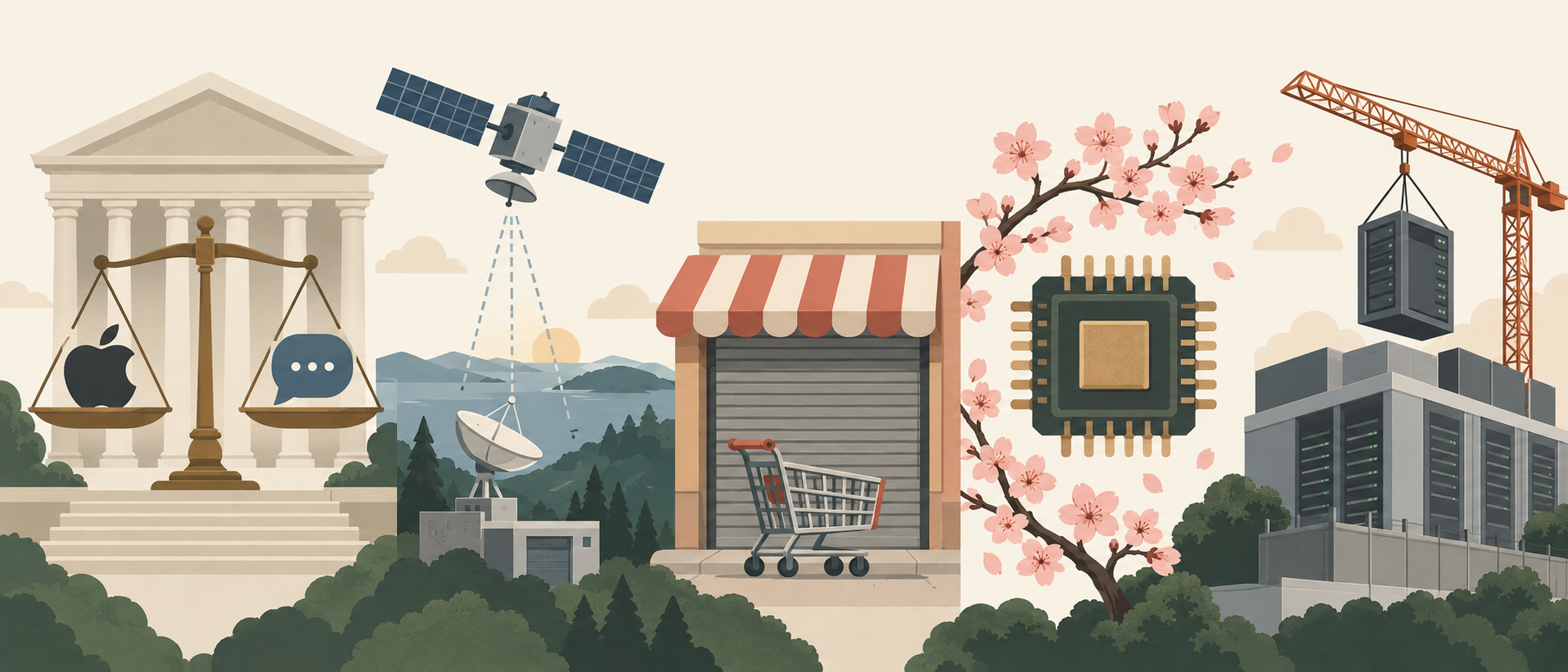
A courtroom fight between two giants: OpenAI countersued Apple, accusing it of stealing trade secrets for future devices. Elon Musk says Google wants to rent even more computing capacity from SpaceX, on top of a deal already worth $920 million a month. AI shopping agents are colliding with retailers that block them, Japan's Sakana AI laid out plans for a homegrown foundation model, and CNBC reports from Texas on the construction-worker shortage straining the data-center boom.
Courts and compute
1OpenAI countersues Apple, accusing it of stealing trade secrets and scaring off hardware suppliers
OpenAI filed counterclaims in California federal court on Friday, CNBC and Reuters report, accusing Apple of stealing its trade secrets and discouraging hardware suppliers from working on future OpenAI devices. The filing answers Apple's own lawsuit, which accuses OpenAI of poaching Apple employees to gain access to its technology.
OpenAI says Apple's employment practices were designed to "trap" employees and keep them from working on competitors' technology. It claims Apple obtained confidential information by rehiring a former employee who spent six months at OpenAI and accessed details of a new device and OpenAI's hardware roadmap, adding that "given the timing, it now appears that stealing those documents may have been his reason for joining OpenAI in the first place." OpenAI says its AI-enabled personal devices threaten to "outcompete Apple on what Apple views as its own turf."
Apple denied using the rehired employee to access OpenAI's confidential information and denied trying to suppress competition in AI devices, calling the counterclaims "a transparent attempt to distract from the substance of Apple's lawsuit." OpenAI and the employees deny Apple's allegations and say Apple's case relied on unauthorized monitoring of one employee's personal messages after he left Apple.
In plain English
The two companies are now suing each other over the same fight, and both sides say the other one cheated.
Why it matters
These are accusations in court filings from both sides. Nothing has been proven, and OpenAI has not publicly shown the device at the center of the dispute.
2Musk says Google wants to rent more computing capacity from SpaceX, which already bills it $920 million a month
Elon Musk said in a Saturday post on X that Google is interested in renting more computing capacity from SpaceX, without giving details, CNBC reports. Musk, SpaceX and Google did not respond to Reuters' requests for comment.
SpaceX already has a multi-year cloud agreement with Google, announced in June and signed before SpaceX's blockbuster IPO, under which Google pays SpaceX $920 million a month from this October to June 2029. The capacity includes about 110,000 Nvidia GPUs plus CPUs, memory and other components. In May, Anthropic said it had reached its own deal to use SpaceX's computing resources, and a June regulatory filing put SpaceX's compute agreements with Anthropic and Google at more than $70 billion combined.
SpaceX is also expanding beyond its Memphis-area hub: it said this month it would spend more than $74 billion on a new supercomputer facility at Starbase in the Rio Grande Valley in Texas and a second campus in Cochise County, Arizona.
In plain English
SpaceX is turning its data centers into a business of their own, and the biggest AI companies are lining up as customers.
Why it matters
The only word on new Google interest is Musk's own post. The $920 million figure comes from the existing deal's announced terms, not the new claim.
3AI shopping agents are having a moment, but Amazon and a growing list of retailers limit or block them
CNBC reports that agentic shopping - AI tools that browse and buy on a user's behalf - is running into resistance from retailers. Walmart and Sephora have opened their sites to agents, while Amazon, eBay, United Airlines and Kohl's limit what agents can do or block them outright, and some companies have added terms-of-service language saying they are not liable when an AI-driven purchase goes wrong.
One example: a shopper asked Meta's Muse agent to buy windshield wipers from AutoZone, and about 17 hours later the agent reported the order was canceled, telling her "the most reliable path now is you ordering on Amazon yourself." Forrester analyst Emily Pfeiffer calls the landscape "a very mixed bag" that keeps consumers from seeing all their options. Even so, McKinsey and ICSC forecast in April that US agentic commerce could reach up to $1 trillion by 2030, and Walmart this week touted its Meta partnership for Black Friday deals. Shopify's president has predicted this will be the first holiday season where AI-driven shopping goes mainstream, and Instinct CEO Noah Shinn told CNBC, "We can obviously move very fast and certain businesses cannot. So, how can we collaborate with them?"
In plain English
The AI that shops for you only works where stores let it in, and many big stores are keeping the door half-shut.
Why it matters
The $1 trillion figure is an analyst forecast, not a measurement, and one canceled order is an anecdote rather than data on how often agents fail.
4Sakana AI will build Sawara, a Japanese foundation model aimed at industry, manufacturing and national security
Sakana AI co-founder and CEO David Ha told TechCrunch that the Tokyo startup's upcoming foundation model, Sawara, is part of a broader goal of strengthening Japan's industrial and manufacturing sectors with AI. Ha also cited rising cybersecurity threats and said Japan needs domestic AI alternatives for sensitive applications in case access to foreign models becomes limited. Work on Sawara begins this month, with a smaller model planned for early 2027 and a larger version to follow; the small model is meant for on-premises use.
Sakana already runs Fugu, a system that assembles agents from other companies' language models, and Namazu, which fine-tunes open-weight models from Meta and DeepSeek for Japanese language and business needs. Ha said open-weight models cannot be used as-is by Japanese enterprises because "they're usually biased towards their creators." Sakana signed a research contract with Japan's Ministry of Defense in July and has worked with the Ministry of Internal Affairs and Communications on detecting disinformation. Ha also said reported IPO timing and valuation figures are speculative and that Sakana has no near-term listing plans, though it has "a gravitational pull to eventually IPO in Japan."
In plain English
Japan's best-known AI startup wants its own home-built model rather than renting intelligence from abroad, starting with factories and government work.
Why it matters
The plans and timelines come from Sakana's CEO. Sawara does not exist yet, and the company has not said how it will fund training at frontier scale.
5The data-center boom is straining construction labor, and Texas shows both sides of it
CNBC traveled to Abilene, Texas, where thousands of workers have arrived to build projects like the $500 billion Stargate campus for OpenAI, Oracle and SoftBank. Local homebuilder Gene Lantrip calls the boom "a two-edged sword": business is strong, but costs and build times are rising because skilled workers keep leaving for better-paid data-center jobs. Master electrician Scotty Wristen said he knows of one company that "lost 42 guys in one day," and that data centers "pay at least triple" what he can offer.
The shortage is national. Associated Builders and Contractors estimates the industry needs to attract 349,000 net new workers in 2026 just to keep pace with demand. Meta, Google and Amazon are spending millions on training programs, including Meta's $115 million American Workforce Academy, run with the ABC. The crunch lands as President Trump says companies will face a "tremendous tax" for building data centers outside the US, and as communities push back against the facilities.
In plain English
There are not enough electricians and builders to put up AI data centers fast, so they are bidding workers away from building everything else.
Why it matters
The 349,000 figure is a trade-group estimate, and the sharpest accounts are individual anecdotes from one Texas city.
Checked against original announcements and named press reports on the morning of November 28, 2026. Story 1 rests on court filings and company statements from both sides. Story 2 rests on Elon Musk's own post, with no confirmation from Google or SpaceX. Story 3 includes an analyst forecast and a single shopper's experience. Story 4 rests on an interview with Sakana AI's CEO about plans, not shipped products. Story 5 combines a trade-group estimate with on-the-ground reporting from one city.