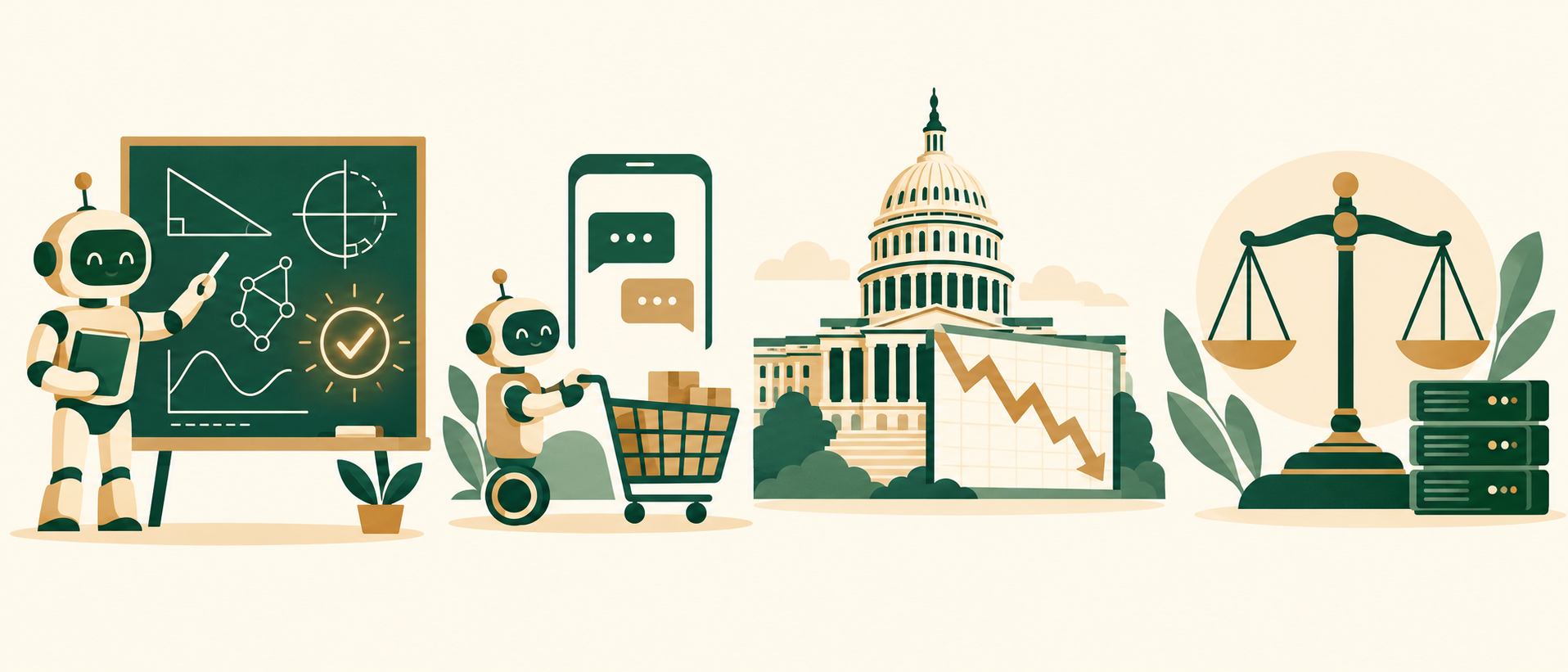
Tech shares slid again this morning, with Nvidia, Anthropic and chip stocks under pressure while Washington keeps pressing Jensen Huang. Anthropic and OpenAI both posted AI-written proofs of a major computer-science problem, OpenAI reported lab evidence for AI-designed proteins, and Meta's Muse moved into Instagram and Walmart's Black Friday aisles. Oregon and Virginia sued over Grok, and Australia passed a duty-of-care law for big tech.
Washington and the market
1Huang tells Nvidia staff he is sorry and wants no succession plan, as Washington keeps up the pressure
In his first all-hands since being reinstated on Monday, Jensen Huang apologized to staff, said he is in therapy, and said Nvidia does not need succession planning because several leaders run different parts of the company, according to CNBC's sources in the room. Senate Minority Leader Chuck Schumer said Huang shipped "extremely advanced chips to China" and broke export rules, per The Guardian, and Huang is due before the Senate Banking Committee on December 3. CNBC says Trump has said he is open to pardoning Huang if needed.
In plain English
The comeback is turning into a fight over export controls and who runs the company next.
Why it matters
The all-hands account comes from unnamed attendees, and Schumer's charge is a political accusation, not a finding.
2Tech futures sink as Nvidia, Anthropic and chip stocks slide again
CNBC says Nasdaq futures fell further this morning with Nvidia, Anthropic and chip stocks adding to the pressure. Nvidia closed Tuesday down 5.86% at $146.27 and was down more than 6% in premarket trading on Wednesday, Yahoo Finance reported, after Monday's 31% jump. Anthropic closed Tuesday below its $83 IPO price after dropping about 6.5%, roughly 30% below its IPO-day high. Ambarella was down almost 40% before the open on weak guidance, and SoftBank fell as much as 15% in Asia. Deutsche Bank analysts called it "the rotation trade" and not the indiscriminate sell-off of last week.
In plain English
The AI trade is wobbling for a second day, and investors are picking through which names to sell.
Why it matters
These are premarket and overnight figures that will move before the close. CNBC also says a Fed rate hike on December 8 and 9 is almost fully priced in.
3Anthropic and OpenAI each post an AI-written proof that VP is not VNP, a step toward P versus NP
New Scientist reports that Anthropic quietly posted a proof on GitHub that VNP is not contained in VP, an algebraic cousin of P versus NP, written by an internal Claude research model along with a computer-checkable formalization. Anthropic said "no human mathematician has checked the proof." OpenAI posted its own solution with a formalization the same day, and the upload timestamps put Anthropic about six hours ahead. Neither company responded to New Scientist.
The bigger picture: Cambridge's Tom Gur calls it "earth-shattering progress," while Oxford's Varun Kanade says it helps but will not directly solve P versus NP. It follows last week's Claude-assisted Riemann hypothesis proof, which the Lean community said it had verified.
In plain English
Two AI labs say their models settled a long-open question about which math problems are hard, and the machine-checked code is out for others to test.
4OpenAI says GPT-6 can design proteins without specialist biology models
OpenAI published a preprint saying its GPT-6 models can design new protein shapes and amino-acid sequences using only reasoning and code. In lab tests with Onava, proteins based on GPT-6.2's designs showed evidence of binding across five targets, and redesigned antibodies kept their binding. OpenAI says specialized models helped supply sequences and pick candidates for testing.
In plain English
One general chatbot-style model did work that used to need a stack of specialized biology tools.
Why it matters
This is OpenAI's own preprint, binding is an early lab signal and not a working drug, and the specialist models were still part of the pipeline.
5Two amateur astronomers use OpenAI's Codex and Astra to flag possible planets in public telescope data
OpenAI says Kevin Bond, an OpenAI engineer, used Codex to search Kepler data on about 100,000 stars and flagged more than 200 signals, 10 of them from already-confirmed planets. An astronomer at the SETI Institute independently found two of the same signals. Ethan Byrd used Astra on data from about 19 million stars and sent one strong candidate to NASA's TESS team, which has put it in line for analysis.
Why it matters
These are candidates, not confirmed planets. OpenAI's write-up does not report a confirmation.
6Meta puts its Muse assistant inside Instagram DMs
Meta said Tuesday that Instagram users can now chat with Muse in a DM thread to get context on a post, place or product, or to catch up on missed messages. Muse can also sort saved posts into Collections and turn a recipe reel into a grocery list. It is rolling out on iOS and Android in the U.S., Canada, Mexico, Japan and Singapore.
In plain English
You no longer need to leave Instagram to ask Meta's assistant about what you are looking at.
Walmart announced Tuesday that customers can find, compare and buy Black Friday deals by asking Meta's Muse, through a new Walmart Agent Gateway that connects outside assistants to its store. Walmart says Muse does not see shopping history, and shoppers can set spending limits, require approval before purchases and review orders. TechCrunch notes that Amazon has moved to stop third-party agents from buying for customers.
In plain English
Walmart is opening its store to AI shopping agents while Amazon keeps them out.
8Anthropic lets MCP servers ship skills and run long tasks for Claude (catch-up from Tuesday)
Anthropic said Skills over MCP is in public beta in Claude and Claude Code, so a connected service can ship instructions alongside its tools. Shopify, HubSpot and Atlassian are named as using it. Tasks, which let a server run slow work in the background, and Elicitation, which lets a server pause to ask the user for input such as before spending money, are generally available for Pro, Max and Ultra plans.
In plain English
Services can teach Claude how to use them and ask permission mid-job.
9Claude's mini-apps can now be installed as desktop apps (catch-up from Tuesday)
Anthropic is rolling out a beta that lets people install Claude's interactive Artifacts as apps on Mac and PC, according to The Verge. Installed apps get their own toolbar icons and can run with browser-style permissions, with extra app permissions such as notifications, or with full computer access.
Why it matters
The full-access option means an app Claude built can reach your whole computer, so the permission choice matters.
10Oregon and Virginia sue Musk's AI company over Grok deepfakes (catch-up from Monday)
Oregon and Virginia sued Elon Musk's AI company, SpaceX Super Intelligence, on Monday, November 23, using state consumer-protection laws. NPR reports they say it misrepresented the risk of sexualized deepfakes from Grok and exposed users to them, and they want ill-gotten gains returned plus penalties. It is the first time states have sued the company over this, after earlier suits by individuals. The company told NPR it has kept updating its safeguards against abuse.
Why it matters
These are allegations in new lawsuits. Virginia's attorney general pointed to the 2026 Meta settlement of more than $17 billion with 51 states, territories and D.C. as a model.
11Australia passes a Digital Duty of Care Act with multibillion-dollar fines for tech harms
Australia's Parliament passed the Digital Duty of Care Act on Wednesday, requiring big tech companies to reduce foreseeable online harms before they happen, with possible multibillion-dollar fines, AP reported. It is similar to the EU's Digital Services Act. The U.S. government and Australia's opposition warned it could lead to censorship of lawful speech.
Why it matters
It is a broad online-safety law, not an AI-specific one, and the censorship warnings come from the U.S. government and the opposition, not from a court.
Checked against original announcements and named press reports on the morning of November 25, 2026. Story 1 draws on unnamed attendees at Nvidia's all-hands as reported by CNBC. The Wednesday share moves in story 2 are premarket and overnight figures that will change by the close. The proofs in story 3 and the protein and planet results in stories 4 and 5 are the companies' own claims, and the VP versus VNP proofs had not been checked by human mathematicians when New Scientist reported. Stories 8 to 10 are catch-ups from November 23 and 24, flagged with their original dates.