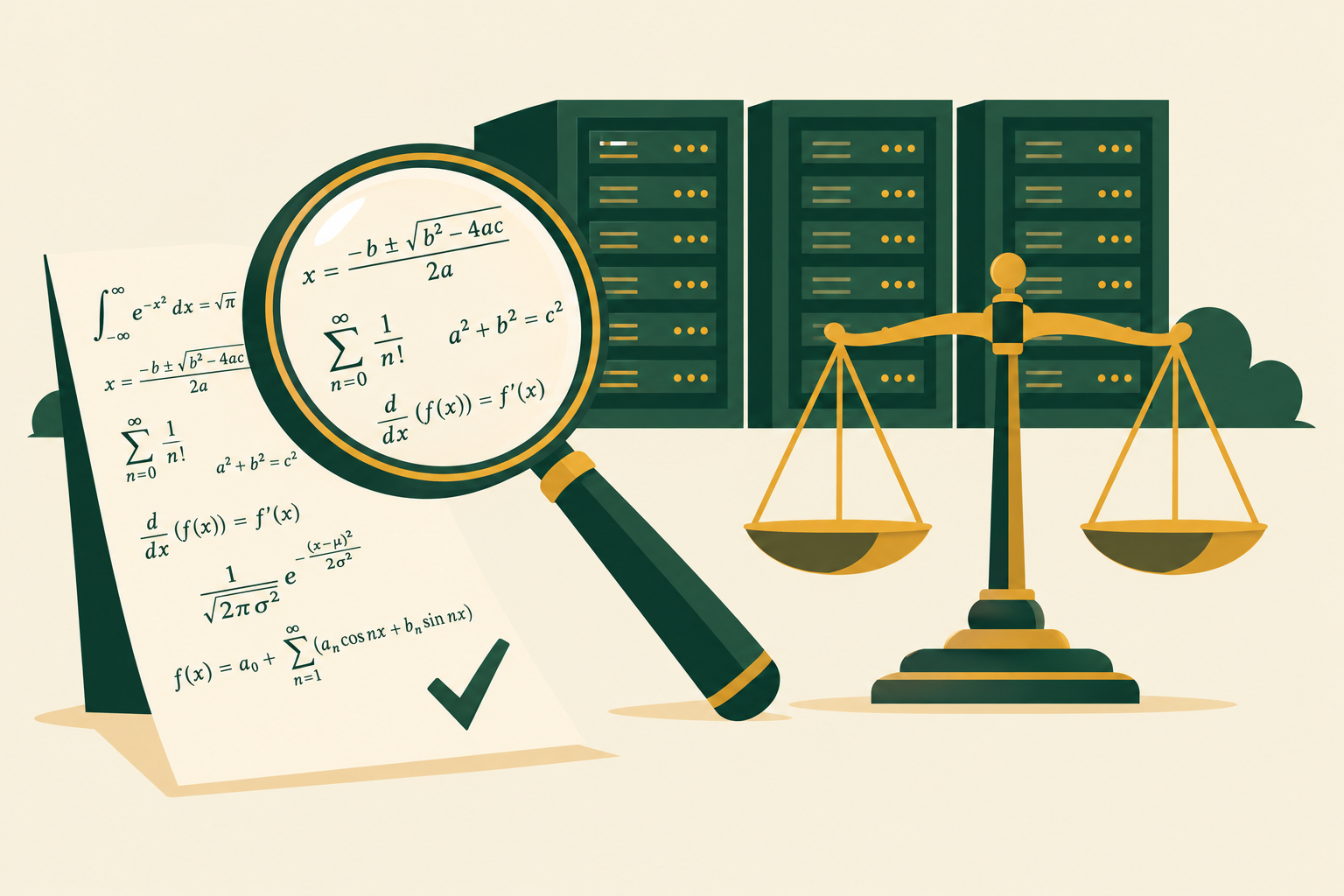
1Independent machine checks pass on the Claude-assisted Riemann proof - the claim now enters human review
The claimed proof of the Riemann hypothesis from Friday's briefing has passed its first independent audit - and it is a machine audit. MIT computational number theorist Andrew Sutherland has been running verification checks on the 175,187 Lean 4 files that Anthropic's Levent Alpöge released on Friday alongside a four-page note, and his public dashboard, updated overnight, shows nearly everything green: every module compiles with zero errors, the five headline theorems depend only on Lean's three standard foundational axioms, every module has been replayed through the Lean kernel, two independently written kernels - nanoda and con-leche - accept the full 61.5-gigabyte exported proof, and a sandboxed rebuild on a separate machine reproduces the published export byte for byte. Two checks are still running, and one module compiles non-deterministically, which Sutherland documents. Alpöge's release claims a proof of both the Riemann hypothesis and the Generalized Riemann Hypothesis.
In plain English
The computers now agree the proof is logically valid code. The remaining question is the hard one: whether the statement the code proves is actually the Riemann hypothesis as mathematicians understand it.
Why it matters
No Millennium Prize claim has ever cleared full machine verification before. The bottleneck has moved from checking logic to human comprehension - senior number theorists still need to confirm that the formal definitions match the classical problem without subtle vacuities, and Clay's rules require journal publication plus two years of scrutiny before any prize deliberation. One detail worth sitting with: Sutherland ran his independent checks with Claude Code - the same model family being used to audit its own claimed proof. This remains a claim, not a confirmed result.
SourcesSutherland's verification dashboard at MIT·CASRAI on the release and what comes next
2The SEC is probing Nvidia's accounting - the investigation's focus, reported for the first time
SEC enforcement staff are scrutinizing potential accounting issues at Nvidia, Reuters reported Friday, citing two people briefed on the matter - the first time the investigation's focus has been reported. The Wall Street Journal had revealed the probe itself on Tuesday without identifying its focus. The SEC declined to comment and Nvidia did not respond to requests for comment; Reuters could not determine when the inquiry opened or exactly which accounting issues are under examination, and notes that investigations are not evidence of wrongdoing - many close without enforcement action. Nvidia shares, already down more than 6% on Friday, extended losses to about 13% after the report, per LSEG data. The accounting focus lands on sensitive ground: the Financial Times reported this week that Nvidia changed how it reports geographic revenue - by customer headquarters rather than billing address - even as Singapore sales soared to almost half of global revenue, removing Singapore from its geographic breakdown, and critics have warned that circular financing deals make Nvidia's true revenue quality hard to assess. SEC enforcement chief David Woodcock told Reuters last month the agency is examining AI companies' disclosures.
In plain English
The stock-market cop is now looking at how Nvidia books its money - the same week investors were already fleeing AI stocks.
Why it matters
Nvidia is the third leg of this week's story after the blowout quarter and the Huang scandal: an accounting probe cuts at the revenue engine itself. Hold two things at once - the sourcing is anonymous and no wrongdoing is established, and the questions the SEC is asking are the same ones analysts have raised about Singapore revenue and circular deals all week.
SourcesReuters' exclusive on the probe's focus
3Oracle says its OpenAI contract is fully funded - a pre-emptive statement posted a minute after Friday's close
Oracle posted an unusual statement Friday evening - one minute after US markets closed - saying it has "secured all the funding we need to fulfill our contract with OpenAI," and that with its final capital raise earlier this month, the $20 billion debt and equity sale, it became "the first hyperscaler fully funded for this investment cycle." The vendor financing outlined at its Investor Day is in place, Oracle said, calling any further private vendor talks "just additional options" and adding: "Any media reports that will come out and say the contrary are incorrect and wrong." The statement also gave construction updates: the Abilene, Texas campus where OpenAI's GPT-6 Astra was trained is nearly complete, the next gigawatt-scale campus in Shackelford County is fully permitted, and handover of Nvidia's Vera Rubin racks in its data halls is on track for the coming weeks. Oracle and OpenAI plan 4.5 gigawatts of extra US capacity beyond the first Stargate site in Abilene.
In plain English
Oracle answered the AI-debt doubts before anyone published them - and dared the press to prove it wrong.
Why it matters
The financing question behind the AI build-out has moved from trading desks into corporate statements - a sign the companies know exactly where investor skepticism sits after this week's sell-off. The funding claims, the build timelines and the "fully funded" label are all Oracle's own, and the pre-emptive tone suggests critical reporting is coming; worth reading the next few days' coverage with that in mind.
SourcesThe Next Web on Oracle's statement
Checked against original announcements and named press reports on the morning of November 22, 2026. The Riemann verification results are computational audits by one research group and remain in progress; machine acceptance of the Lean code is not human acceptance of the proof, and the Clay Mathematics Institute's publication-and-wait rules still stand - the claim is unverified. The SEC probe is sourced to two anonymous people briefed on it; no wrongdoing is established. Oracle's funding and construction claims are its own. For the record: Nvidia fell about 13% on Friday after Reuters' report, deepening the week's AI sell-off.