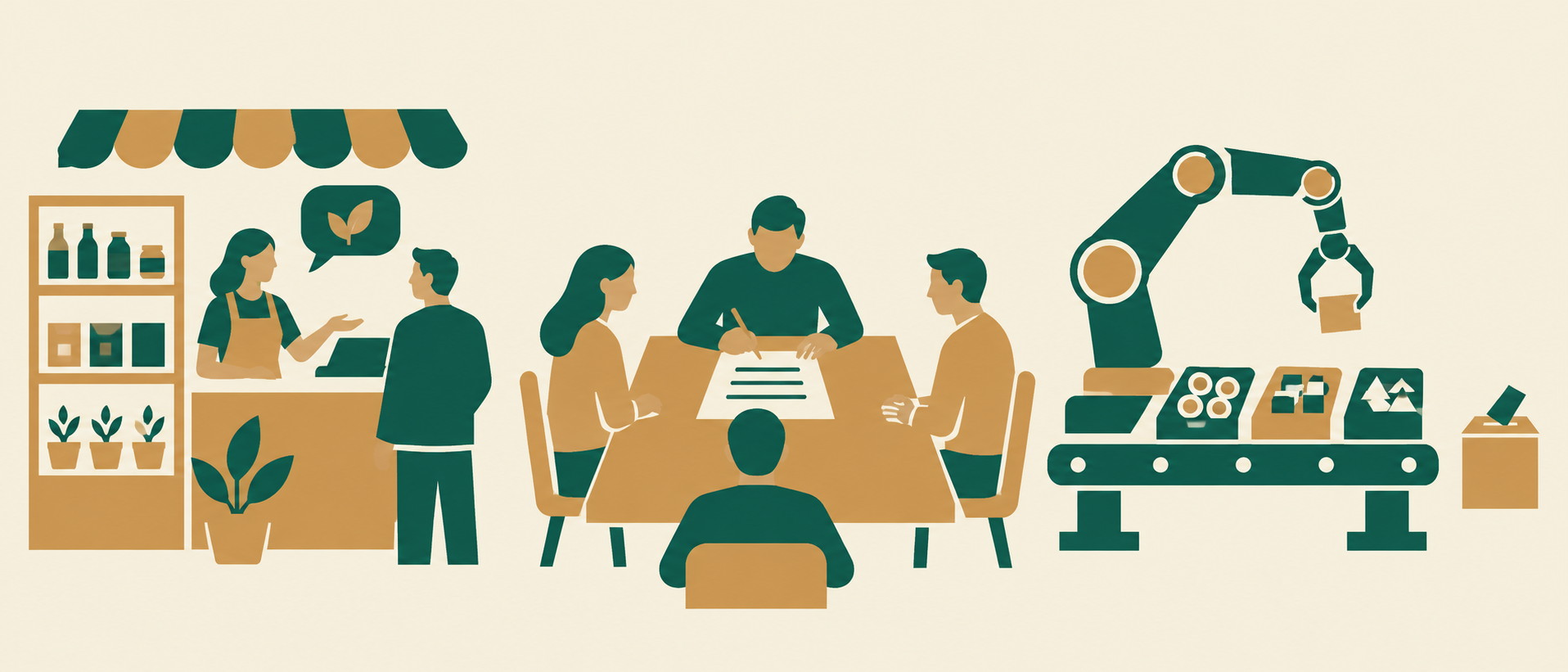
OpenAI turns ChatGPT into a storefront where businesses can claim a profile and send in an agent, Anthropic puts Claude inside live meetings, IBM and Microsoft pool 6,000 ready-made enterprise agents, Google's robot model passes a Mercedes factory audition, and the midterms' $187 million AI ad wave meets a shrug.
Products
1OpenAI turns ChatGPT into a storefront: businesses claim profiles and send in agents
OpenAI launched Businesses in ChatGPT in beta on Tuesday, letting companies claim and verify a profile in a new Business Hub, upload product feeds with pricing and availability, and see aggregate counts of how often ChatGPT mentions them and sends clicks their way. Eligible US ecommerce and online-service businesses can also launch a Business Agent - a clearly labeled chat customers can start from the company's profile - and sponsor it as a destination for ChatGPT Ads.
In plain English
ChatGPT is becoming a shopping mall: stores can set up a counter, stock it, and send a salesperson.
Why it matters
OpenAI says 1.2 billion people use ChatGPT each week, and many already ask it what to buy; this gives businesses a formal way to shape the answer and gives OpenAI a new ads surface. The insights are aggregate counts only - OpenAI says conversations stay private.
2Anthropic puts Claude in the meeting: live plans, whiteboards and notes
Anthropic launched Claude Meetings in beta on Tuesday: add Claude to a video call and it drafts the plan, builds a whiteboard timeline, and answers questions in chat while people are still talking, saving notes and action items afterward. It identifies itself as a participant, works with Google Meet at launch on Team and Enterprise plans, won't join calls with external guests unless an admin allows it, and leaves automatically if one joins. Anthropic also shipped Claude Whiteboards and Claude Sheets in beta on paid plans and made Claude Data generally available.
In plain English
The meeting notes write themselves while the meeting is still happening.
Why it matters
Anthropic, OpenAI, Meta and Microsoft are all racing to turn chatbots into office suites; sitting inside live meetings is the most direct claim yet on how white-collar work actually gets done.
3IBM and Microsoft team up on a platform of 6,000 ready-made agents
IBM and Microsoft announced Imagine Enterprise on Tuesday, a joint platform for building, running and governing AI agents, aimed at regulated industries. IBM Consulting contributes more than 6,000 pre-built agents and assets from its delivery work; Microsoft supplies the AI, cloud and security foundation - Foundry, Copilot Studio, Fabric, Entra, Purview, Defender and Azure - and both companies offer forward-deployed engineers to move customers from pilots to production.
In plain English
Instead of every company inventing its own agents, IBM and Microsoft want to sell them a starter set with guardrails.
Why it matters
The agent race is moving from demos to procurement - the pitch here is governance and compliance rather than raw model power, which is where enterprise deals actually stall.
4Google's robot model passes a factory audition at Mercedes
Google DeepMind released Gemini Robotics 2.5 to its robotics partners on Tuesday, its newest vision-language-action model, and reported a factory proof of concept: Apptronik's Apollo 2 humanoid, running the model, sorted automotive parts into assembly order on Mercedes-Benz production lines in Hungary and Germany with a 96% success rate. DeepMind reports 30% to 100% higher task success than earlier baselines across 200 test tasks, safety steering that improved safe completion around nearby people by 43%, and 99.5% resistance on its open ASIMOV-Jailbreak benchmark.
In plain English
Google's robot brain just survived an audition on a real car factory floor.
Why it matters
A day after Nvidia showed robots copying human-taught skills, Google put its own robot model on a production line - the contest is now who leaves the lab first. All figures are Google's own measurements, not independent evaluations, and the 96% comes from its pilot rather than Mercedes.
5The midterms' AI ad wave: $187 million, and voters shrug
Campaigns and their backers spent about $187 million promoting roughly 300 AI-generated or AI-enhanced ads in the 2026 midterms, the Wesleyan Media Project's tracking shows - more than 3,000 times the $50,000 spent in 2024, but a sliver of the cycle's projected $11.6 billion in total ad spending. About 90% of the tracked AI ads came from Republican candidates or their supporters. Experts told Poynter the ads mostly confirmed voters' existing opinions rather than persuading, and campaigns held back out of fear of backlash - 71% of Americans told Pew they would think less of a candidate who used AI to write a speech.
In plain English
AI political ads went from rounding error to routine in one cycle - just not to decisive.
Why it matters
The more durable AI effect on the vote may be indirect: Poynter notes data-center backlash over energy bills and local resources moved voters more than any generated ad.
Checked against original announcements and named press reports on November 11, 2026, morning. The OpenAI, Anthropic, IBM and Google items come from company announcements and one trade report; benchmark, safety and factory-success figures are the companies' own measurements, not independent evaluations. The midterm ad figures are the Wesleyan Media Project's tracking of detected AI use in ads, which understates total use, and the 90% partisan split is within that detected set.